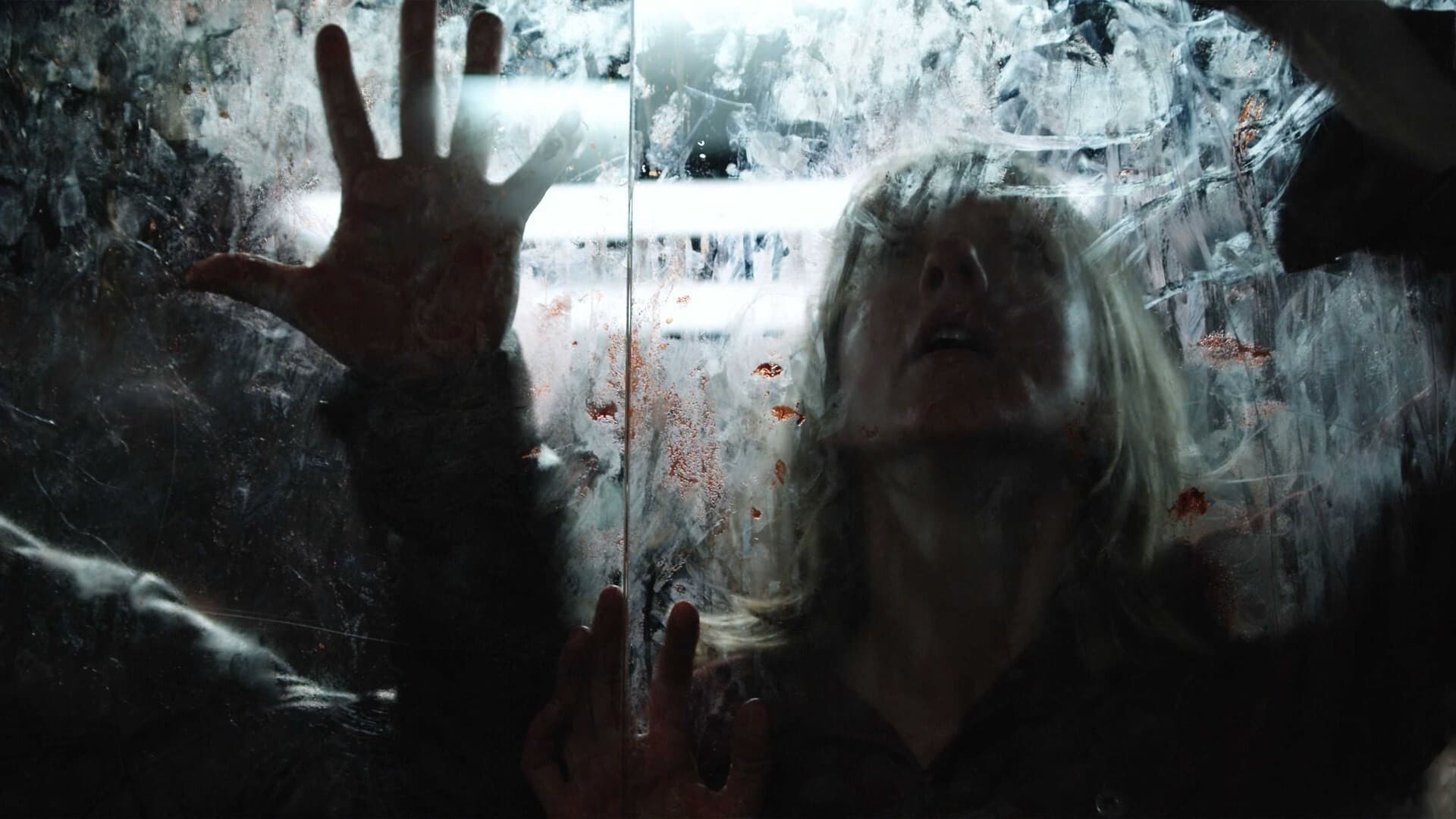

Nobody Has Ever Made a Horror Film Like Pontypool. Most People Have Never Seen It. Fix That.
Bruce McDonald made a zombie movie where the infection spreads through the English language. It is set almost entirely inside a radio station. Stephen McHattie gives one of the great unsung performances in the genre. Fix this.
Allen Erwin·Hellbound Hearts·April 15, 2026·6 min readHere is the central concept of Pontypool, stated plainly so you understand what you're about to go watch: a virus has infected specific words in the English language. When certain people hear or speak those infected words — and understand them — the virus takes hold. It rewires the brain. The infected become something that used to be human and is now focused entirely on finding another person to destroy themselves with.
The entire film takes place in a church basement radio station in a small Ontario town during a snowstorm. Three people. One room. The apocalypse arriving entirely through the phone and the airwaves, described by voices they can't see, while they try to figure out what's happening and how to stop it.
That's it. That's the movie. Now go watch it, because the next few sections are going to talk about why it works and some of that conversation is best had after you've seen it.
No other horror film has ever used language itself as the monster. Not one. That's not an exaggeration — that's just true.
What It's Actually Doing
Pontypool is adapting Orson Welles's War of the Worlds radio broadcast more than it's adapting its own source novel. The horror here is the same horror Welles stumbled onto in 1938 — that the voice on the radio telling you what's happening in the world is the entire world as far as you're concerned. You can't verify it. You can't see it. You have only the words, and the words may be lying, and the words may also be killing you.
Grant Mazzy — played by Stephen McHattie, who has one of the great radio voices and the face of a man who has seen everything and is tired of most of it — arrives at the station expecting another routine morning in a town where nothing happens. What he gets instead is reports coming in of riots, of crowds of people acting like they've lost their minds, of violence spreading outward from what sounds like a doctor's office. The reports keep coming. They keep getting worse. And the three people in that basement — Mazzy, his producer Sydney, his assistant Laurel-Ann — can only listen and try to make sense of something that doesn't make sense yet.
The film withholds its central concept for the better part of an hour. It lets you sit in the same confusion the characters are sitting in. When the explanation finally arrives it's delivered by a doctor who has crawled through a window into the radio station — frantic, certain, completely aware of how insane he sounds — and it lands with the specific weight of a reveal that the film has earned rather than explained.
The apocalypse arrives entirely through the phone and the airwaves. Three people. One room. The world ending in language.
Stephen McHattie
This is one of the great unsung horror performances and the reason the film works as well as it does. McHattie plays Grant Mazzy as a man who has been a bigger deal than he currently is — a shock jock from a major market who ended up in Pontypool because things went sideways somewhere — and that backstory lives entirely in the way he carries himself, the way he talks, the way his producer looks at him with the weary patience of someone who has had this particular argument before. None of it is explained. All of it is clear.
As the situation escalates McHattie does something very specific: he lets you watch a man who has spent his entire career using words to manipulate and perform suddenly confront the possibility that words are the problem. That his voice — the thing he has built his entire identity around — may be the weapon. The performance is doing more work than most reviewers gave it credit for in 2008 and it's doing it quietly enough that you might not notice until after the film is over.
Why You Haven't Seen It
It's Canadian. It had a tiny distribution footprint. The marketing didn't know what to call it — it's technically a zombie film that doesn't show you zombies for most of its runtime, which is a hard sell. The people who saw it at festivals in 2008 and 2009 went evangelical about it, which is exactly what happens to great films that nobody else saw: they develop a devoted underground following that talks about them constantly to audiences who nod politely and never actually watch the film.
The film was ranked the 43rd scariest movie ever made by Consequence of Sound in 2018. It sits at 84% on Rotten Tomatoes. It is available to stream right now on AMC+. There is no good reason you haven't seen it except that nobody sat you down and told you to watch it in terms that made it sound unmissable.
Consider this that conversation.
Pontypool is the only horror film ever made where the monster is the English language. Nobody has made another one. Nobody has come close. Bruce McDonald made it in Canada in 2008 on what was clearly not a large budget and it does things with sound, with voice, with the specific anxiety of receiving information you cannot verify, that films with twenty times the resources have never managed.
Ninety-three minutes. Watch it tonight.
◆ WHERE TO WATCH Pontypool (2008) is currently streaming on AMC+ Also available to rent/buy on most digital platforms Runtime: 93 minutes — Watch it alone, at night, with the lights off
Horror doesn't stop when the article ends.
Get your Scare Score. Talk to Hex. Take the horror quiz. Join a community that lives and breathes horror.
HELLBOUND HEARTS — hellboundhearts.com