
Primate Review: A Rabid Chimp in Hawaii Absolutely Should Not Work This Well
Johannes Roberts made exactly the film he set out to make. The practical effects are genuinely unsettling. An Oscar winner plays a deaf father and you'll spend ten minutes wondering if he's actually deaf. He is.
Allen Erwin·Hellbound Hearts·April 19, 2026·5 minWritten by: Johannes Roberts & Ernest Riera
Starring: Johnny Sequoyah, Jessica Alexander, Troy Kotsur, Victoria Wyant, Gia Hunter
Ben the Chimp: Miguel Torres Umba (practical — no CGI)
Rating: R · Runtime: 1h 29m
Paramount Pictures · January 9, 2026
Now streaming on Paramount+
January horror has a reputation and it has earned that reputation honestly. January is where studios send films they believe in just enough to release theatrically but not enough to put real money behind. It's the dumping ground. The waiting room. The place where perfectly serviceable horror films go to make $11 million opening weekend and disappear before anyone can tell their friends to go see it.
Primate deserved better than January. It also used January well, which is its own kind of compliment.
The premise is exactly what it sounds like: Lucy comes home to Hawaii for the summer, reunites with her deaf father Adam, her younger sister, and Ben — the family's pet chimpanzee, who was raised by their late mother, a linguistics professor who taught him sign language. Then Ben gets bitten by a rabid mongoose in the middle of the night. And then everything gets considerably worse for everyone in that glass cliffside mansion.
But before any of that — before the setup, before the character introductions, before Lucy even lands — the film opens with something that tells you immediately what kind of movie you're in. I'm not going to describe it. You need to see it cold. What I will tell you is that within the first three minutes Primate does something so brutally committed that the question stops being "will this be good" and becomes "how far is it willing to go." The answer, it turns out, is quite far. The kills that follow throughout earn that opening rather than coasting on it — practical, brutal, and occasionally the kind of thing you'll describe to people the next day with a mix of admiration and mild personal concern about yourself for having enjoyed it.
A man in a practical chimp suit is more frightening than any CGI animal in the last decade. There is no debate to be had about this.
The Practical Effects Question
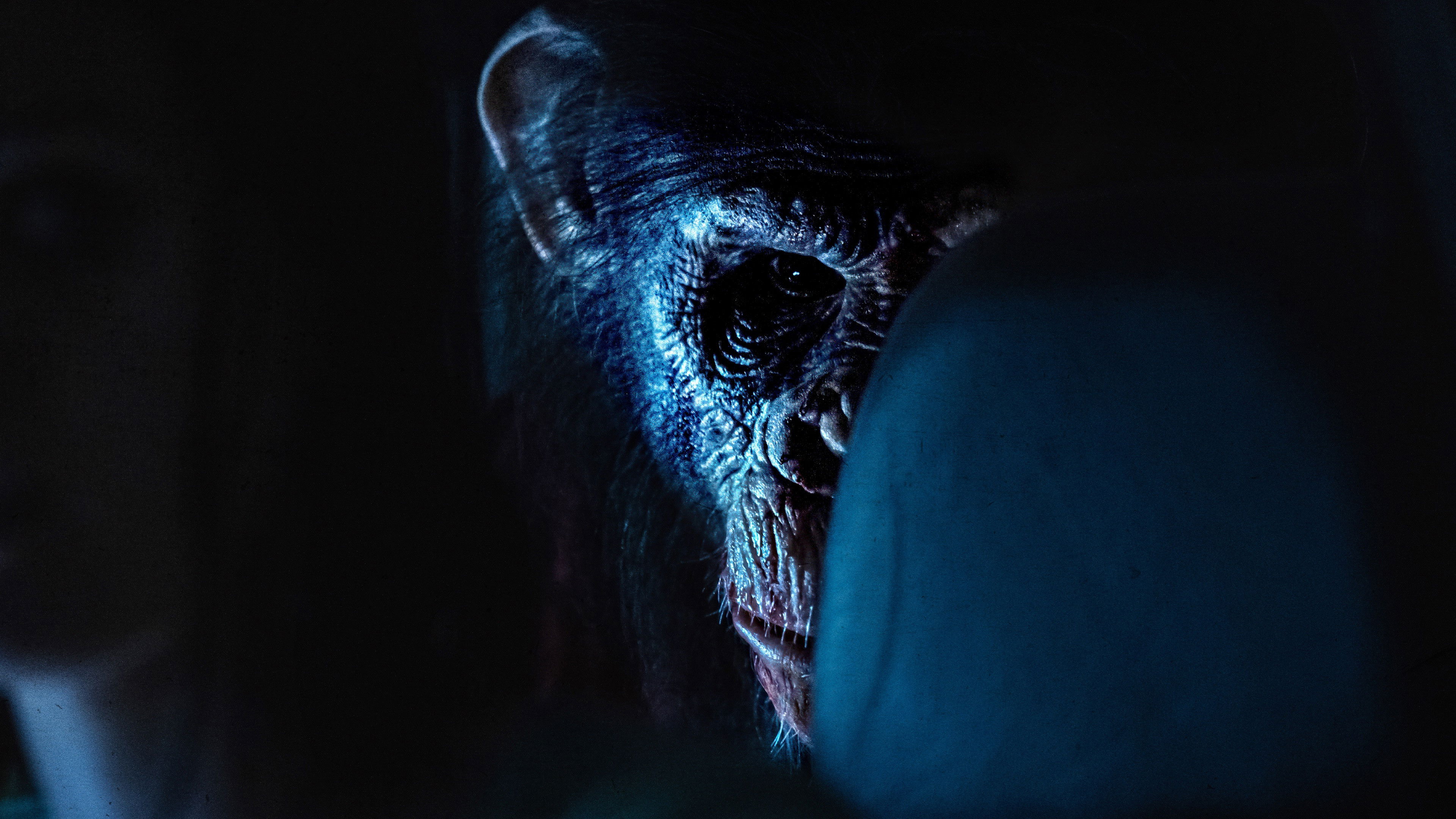
Ben is played by Miguel Torres Umba in a practical suit with prosthetics — no CGI. This is the correct choice and the reason the film works as well as it does. A chimpanzee rendered in CGI is an uncanny valley nightmare that your brain immediately flags as not real. A performer in a well-built practical suit has weight, mass, and physical presence that the camera can't fake and your nervous system can't dismiss. When Ben moves, you feel it. When he attacks, there's a tactile quality that makes the audience press back in their seats in a way that digital creatures simply don't achieve.
The commitment to practical effects is a statement of intent that runs through the whole film. Roberts is not interested in making a slick, modern-looking creature feature. He's interested in making you scared of something physical and real, and he succeeds because he understood that the tool matters as much as the technique.
Troy Kotsur
Troy Kotsur plays Adam, Lucy's father — and if you've seen him in CODA, or in Black Rabbit with Jason Bateman, or as a Tusken Raider in The Mandalorian, you'll notice something: he keeps playing deaf characters. There's a reason for that. Kotsur is deaf. Born deaf, has been deaf his entire life, won the Academy Award for Best Supporting Actor for CODA in 2022 — making him the first deaf male actor to win an Oscar — and has spent his entire career bringing authentic deaf representation to a field that has historically been terrible at it.
The film uses his deafness as more than set dressing. There's a sequence in the second act where Adam's inability to hear Ben approaching becomes the source of genuine sustained tension — not a cheap gotcha, but the kind of dread that builds because you know something the character doesn't and you can't do anything about it. It's the film at its best: using character truth to generate horror rather than just putting a body in front of a threat.
The film uses Kotsur's deafness as a source of sustained dread, not a gimmick. There's a difference and Roberts knows it.
What It Is and What It Isn't
This is not a film trying to say something. It is not elevated horror. It is not interested in your trauma or your grief or your relationship with your mother. It is interested in a rabid chimpanzee in a glass house and the very bad time being had by everyone inside it. That clarity of purpose is its own kind of artistic statement — Johannes Roberts knew what movie he was making and made that movie without apology or pretension.
The characters start smart and stay reasonably smart, which is rarer than it should be in this genre. When people make questionable decisions it's because they're frightened and running out of options, not because the script needs them to do something stupid to set up the next kill. There's a moment where someone needs to get out of the pool to retrieve their phone — she needs the phone, genuinely needs it, the stakes are real — and you know the second she climbs out that she's made a very bad decision for very good reasons. The film puts you in that double bind deliberately. You want her to stay in the pool. You understand why she can't. Roberts holds that tension for exactly as long as he should before paying it off.
Is it perfect? No. The supporting cast thins out as the film progresses and not all of them get enough material to make their fates hit the way they should. The Hawaiian setting, while gorgeous, has almost nothing to do with the story — Roberts shot it on sound stages in London and it shows in a few places. These are the taxes you pay on a January creature feature, and the film earns enough goodwill in its first hour to cover them.
Primate is lean, committed, and anchored by a practical performance from a man in a chimp suit that's more unsettling than anything rendered in CGI this year. 47 Meters Down fans know Roberts can deliver this kind of contained, high-concept creature horror when the pieces align. Here they align. He made exactly the film he set out to make.
It's on Paramount+ now. Watch it with the lights off and someone who will grab your arm at the right moment.
Horror doesn't stop when the article ends.
Get your Scare Score. Talk to Hex. Take the horror quiz. Join a community that lives and breathes horror.
Insidious: Out of the Further Found the Nerve I Didn't Know I Had
I walked in with ankle-height expectations and walked out having discovered a personal squirm button at my age. The new Insidious flips the franchise's core mechanic, weaponizes a PG-13 the right way, and earns back everyone The Red Door lost.
He Never Really Left. That Was the Worst Part.
HELLBOUND HEARTS — hellboundhearts.com