
Videodrome Warned Us. We Owe David Cronenberg an Apology.
In 1983 a Canadian weirdo made a movie about a man who grows a VHS slot in his stomach. America was not ready. Neither were we. He was right about everything.
Allen Erwin·Hellbound Hearts·April 21, 2026·7 min readWritten by: David Cronenberg
Starring: James Woods, Debbie Harry, Sonja Smits, Peter Dvorsky
Makeup Effects: Rick Baker
Country: Canada · Year: 1983
Runtime: 88 minutes · Rating: R
Box office: $2.1M against $5.9M budget (a disaster, at the time)
Now in the Criterion Collection
In 1983 a Canadian man named David Cronenberg made a movie where James Woods grows a vaginal slit in his stomach and uses it to hold VHS tapes. This is not a metaphor I am reaching for. It is a scene in the film. It happens on screen. James Woods puts a videocassette into his own torso. Then he takes it out. Then he watches television.
The movie bombed. Of course it bombed. It cost $5.9 million and made $2.1 million, which by Hollywood math meant Cronenberg had essentially set fire to a car in front of Universal Pictures and then asked them if they wanted to do it again next year. Critics did not know what to do with it. Audiences definitely did not know what to do with it. The only people who seemed to know what to do with it were the small subset of 1983 moviegoers who understood they had just watched a documentary about the next fifty years of human existence and had been too confused by the VHS-stomach thing to mention it to anyone.
Which brings us to the problem. Videodrome was right. About everything. About all of it. And we owe David Cronenberg, at minimum, an apology and a very uncomfortable evening spent rewatching his movie.
He made a film about a guy who grows a VHS slot in his stomach. It was about us. We just didn't have the context yet.
Here Is What the Movie Is About
James Woods plays Max Renn, who runs a small Toronto UHF channel called CIVIC-TV that broadcasts whatever sleazy content he can license for the lowest possible price. Imagine if the worst guy at your local cable access station also owned the station. That's Max. He is looking for his next big hit. His pirate satellite guy intercepts a broadcast called Videodrome — plotless footage, a red-walled room, what appears to be real torture. Max sees a moneymaker. Max is about to have a very bad few weeks.
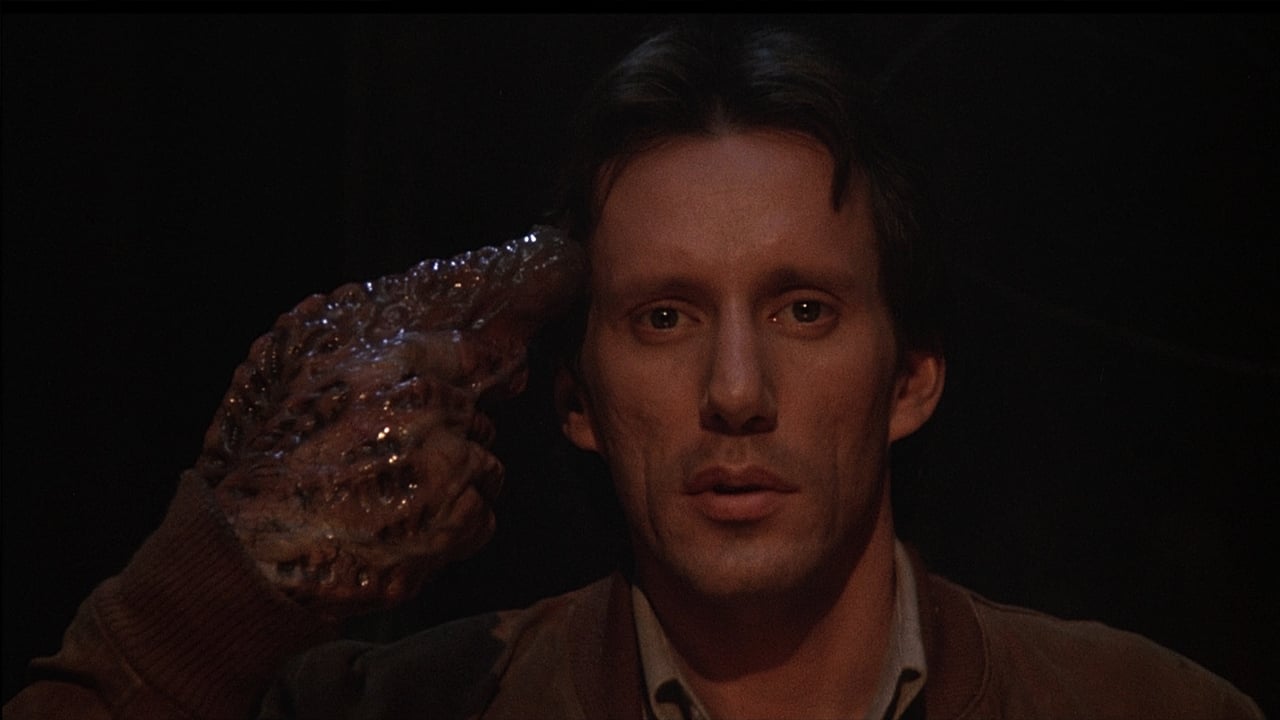
Because Videodrome is not a show. Videodrome is a signal. And the signal, if you watch enough of it with enough attention, produces a brain tumor that produces hallucinations that eventually rewrite your physical body. The tumor is the point. The hallucinations are the delivery mechanism. The new body — Cronenberg calls it the new flesh — is what you become after the signal is done with you. Max becomes a different creature by the end of the film. He also blows his own head off with a hand that has fused with a pistol. Cronenberg is not subtle about any of this.
Now. In 1983 this played as transgressive weirdo art. Imagine going to see a movie on a Friday night in February 1983, your date is hoping for something romantic, and instead you sit through ninety minutes of James Woods slowly turning into a television cabinet. Imagine explaining that to your date in the car afterward. Imagine trying to get a second date. This is the actual environment into which Videodrome was released, and you start to understand why it cratered.
Here Is What the Movie Was Actually About
Us. All along. We just didn't have the context yet.
Consider the state of the world in 1982, when Cronenberg was writing the script. Cable television was new. Home VHS was new. The very idea that you could consume unlimited amounts of whatever kind of imagery you wanted, in your own house, whenever you wanted to, was a novel cultural development. Parents were worried. Critics were worried. Nobody had a framework yet for what happens to the human nervous system when you hook it up to a firehose of imagery with no off switch.
Cronenberg had a framework. His framework was: the imagery is going to rewire your body. The screen is going to become an organ. The device is going to stop being a device. The flesh is going to change to accommodate the signal. He wrote this in 1981. Then he put it on screen in the form of James Woods growing a VHS slot in his stomach because he correctly assessed that nobody was ready for the literal version.
The device is going to stop being a device. The flesh is going to change to accommodate the signal. He wrote this in 1981. Then he went home to Toronto.
Now think about your phone.
Specifically think about where your phone is right now. Is it within arm's reach? If not, is it within eye contact? When was the last time you went more than an hour without looking at it? When you're separated from it, do you feel a physical sensation that could fairly be described as distress? Does your body reach for it before your brain consciously decides to? Has your capacity for sustained attention measurably changed in the last ten years? Have you noticed that other people's has?
Cronenberg described this condition in 1983 and nobody understood because it hadn't happened yet. He just saw it coming. He also correctly identified that the change would be physical, not just behavioral, which is a thing neuroscientists are now confirming in peer-reviewed journals forty years later. Our brains are actually different. Our eye movement patterns are actually different. Our dopamine systems are actually different. We are, in a measurable and documented way, a new flesh. The new flesh is just us. We didn't notice because it happened one software update at a time.
The Other Things He Got Right
The signal is broadcast by a cabal of bad actors who use it to identify and radicalize susceptible viewers into becoming instruments of political violence. This is the actual plot of the movie. There is a scene where the villain explains it to Max in straightforward dialogue. In 1983 this read as lunatic paranoia. In 2026 it reads as the boring policy section of a Congressional hearing on algorithmic radicalization. Cronenberg called it Videodrome. We call it the For You page.
Nicki Brand, played by Debbie Harry in her first major film role, is a radio host who watches Videodrome and finds it sexually arousing and wants more of it and wants to audition for the show and wants, specifically, to be hurt by it in the same way the people on screen are being hurt. The film treats this neither as pathology nor as liberation but as something in between. It treats her as a woman responding to a cultural environment that has industrialized eroticism to the point where ordinary intimacy has lost its charge. Which, if you look around in 2026, is the OnlyFans economy, the content creator landscape, the specific flattening of desire into content that can be consumed. Harry's performance in this film is one of the most accidentally prophetic things any actor has done on camera. She was playing a woman who was twenty years ahead of her own cultural moment and you can feel the film straining to find the vocabulary.
The inability to distinguish broadcast from reality. Max spends the back half of the film unable to tell whether what he is experiencing is happening in the world, on a screen, or inside his own compromised perception. This is now a design feature of contemporary life rather than a horror premise. Every time you see a video and wonder whether it's AI. Every time you see a political clip and wonder whether it's been edited. Every time you see a photo of yourself from a decade ago and realize you don't remember the moment because the photo has replaced the memory. That's Max. That's all of us. Cronenberg just got there first.
Why This Is Still a Great Horror Film
Here is the thing nobody mentions when they talk about Videodrome in the prophetic-genius mode: it also rips. It is a legitimately great piece of body horror that happens to also be a piece of media criticism that happens to also be one of the weirdest films ever financed by a major Hollywood studio. All three things are simultaneously true and all three things remain true forty-three years later.
Rick Baker did the effects work. Rick Baker had won an Oscar two years earlier for An American Werewolf in London, which means the same hands that turned David Naughton into a wolf turned James Woods into a television. The pulsing TV screen. The gun-hand fusion. The VHS-stomach. These are practical effects built on set with foam and latex and silicon and they remain more unsettling than anything CGI has ever achieved because your nervous system can tell when something is actually there. Your nervous system is still somewhat capable of that, at least for now, until the signal finishes its work.
James Woods plays Max as a guy who starts the film as someone you'd cross the street to avoid and ends the film as the only character left with the capacity to notice what has happened to him. It's a performance that gets better every decade because every decade his starting point becomes more normal and his ending point becomes less horrifying and more recognizable. The film's central unease is watching Max become us. He just got there early.
Debbie Harry, who by the way is also the lead singer of Blondie, which I mention because the film does not mention it and expects you to already know, brings a detached erotic gravity to the role that none of the other actors can match. She plays Nicki like someone who has already made peace with her own disappearance into the signal. When she tells Max she wants to audition for Videodrome, there is no hesitation in it. She is already gone. The film is just waiting for her body to catch up.
Also available to rent on most digital platforms
Runtime: 88 minutes — Watch it alone and tell nobody afterward
Long Live the New Flesh
The film ends with Max, fully transformed, pointing his gun-arm at his own head. The voice of Nicki — who may or may not exist at this point, the film is gloriously unclear about this — tells him what to do. Long live the new flesh, he says. Then he shoots himself. Roll credits.
In 1983 this was read as ambiguous. Pessimistic. Maybe liberating. Cronenberg himself has said he meant it as a rebirth — Max shedding his human body to become something new, something that exists only inside the signal. The new flesh was supposed to be the next evolutionary step. The next thing we become.
In 2026 this ending has a different flavor. We are the new flesh. Not metaphorically. Not speculatively. Our bodies are different from our parents' bodies. Our brains process information differently. Our attention patterns, our relationships, our sense of what's real and what's not — all of it has been reshaped by the signals we have spent our lives consuming. We are not who we would have been without screens. We are who the screens made us. We are the ending Max reached at the end of his movie, except our version came without the dramatic gun-arm sequence and happened more slowly and nobody bothered to film it because we were all on our phones.
Put Videodrome on tonight. Do it the hard way. Turn the lights off. Put your phone in a drawer in another room. Try to watch it the way a confused 1983 moviegoer watched it, without knowing what was coming, without knowing it was describing you.
Then take your phone out of the drawer and notice how fast you reach for it.
Long live the new flesh.
Horror doesn't stop when the article ends.
Get your Scare Score. Talk to Hex. Take the horror quiz. Join a community that lives and breathes horror.
HELLBOUND HEARTS — hellboundhearts.com