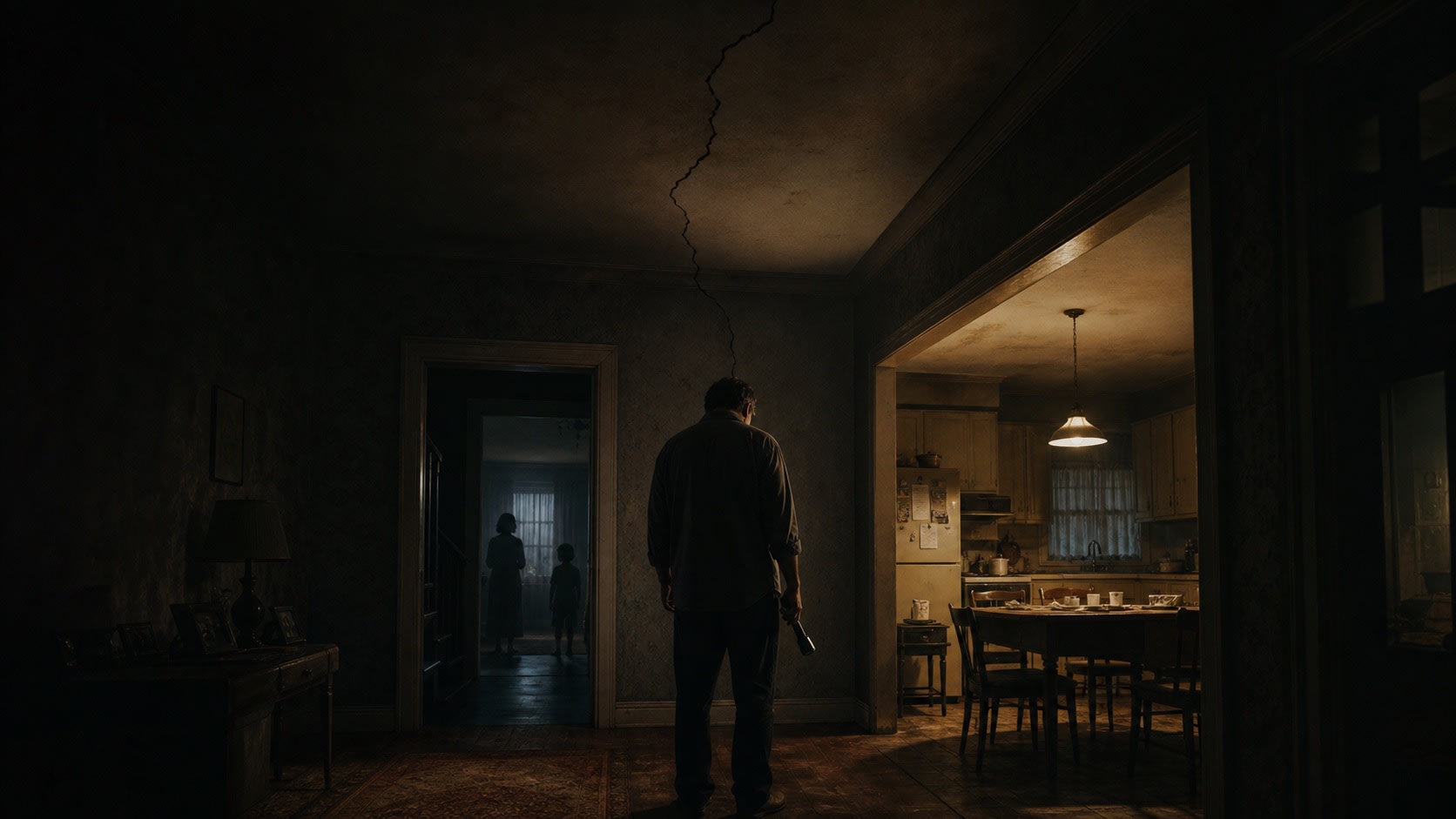

Horror’s Worst Dads: A Father’s Day Catalog of Cinematic Failure
A brief and incomplete inventory of the genre’s most catastrophic patriarchs, and what they tell us about why horror keeps coming back to fatherhood.
Allen Erwin·Hellbound Hearts·June 22, 2026·7 min readThere's a specific subgenre of horror that nobody officially calls a subgenre, but it's real and it has rules. The Bad Dad Movie. The Failing Father. The Patriarch Who Cannot Protect, Cannot Listen, Cannot Hold the Center While the Family Comes Apart. Horror has been making these films since Stephen King looked at his own family in Boulder, Colorado in the seventies and wrote a novel about a writer who tries to murder his wife and son in a haunted hotel.
This is not an accident. Horror writes about fatherhood more honestly than any other genre because horror is the only genre that takes the stakes seriously. A bad dad in a drama is a sad story. A bad dad in horror is the end of the world for one specific family.
So today, on Father's Day, here's a brief and incomplete catalog of horror's worst fathers, and what each of them tells us about the genre's complicated relationship with the role.
Jack Torrance, The Shining (1980)
The patron saint of failing fathers. Jack Nicholson playing a recovering alcoholic writer who takes his family to an empty hotel for the winter and slowly, methodically, demonstrably loses his entire mind. The film's genius is that Jack was already losing it before the Overlook helped him along. The hotel just accelerated what was already in motion. Stanley Kubrick understood that the scariest part of fatherhood isn't a sudden break but a slow one — the long erosion of a man who was supposed to be in charge of something he turned out not to be capable of holding together. Jack is the version of fatherhood that horror has been responding to and refining for forty-five years.
The scariest part of fatherhood isn't a sudden break but a slow one — the long erosion of a man who was supposed to be in charge of something he turned out not to be capable of holding together.
Louis Creed, Pet Sematary (1989, 2019)
A father who cannot accept loss and so makes loss permanent. Louis loses his son Gage to a truck on a country road, and instead of grieving, he digs the boy up and buries him in a cursed Micmac burial ground in the woods. Gage comes back. Gage is not Gage anymore. Louis loses his wife next, makes the same mistake again, and the movie ends with him sitting in the kitchen waiting for whatever is wearing his wife's body to walk in. The horror is that Louis is not a bad man. He's a doctor. He's a provider. He just couldn't bear the one thing fatherhood absolutely demands you bear, which is the possibility of losing the child you were supposed to protect.
Ellison Oswalt, Sinister (2012)
A true-crime writer who moves his family into the literal house where a murder occurred so he can research his next book without telling his wife the actual address has historical significance. Ellison Oswalt is not possessed. Ellison Oswalt is not under demonic influence. Ellison Oswalt makes the choice to gamble his family's safety against the possibility of a bestseller, and the film's killer twist is that the supernatural element only shows up to punish him for the perfectly mundane sin of valuing his career over his children's lives. Ethan Hawke plays him with the specific weight of a man who knows what he's doing is wrong and does it anyway.
Oskar, The Babadook (2014)
A father who died in a car accident driving his pregnant wife to the hospital to give birth to their son. He never gets a chance to fail at fatherhood because he never gets a chance to do it at all. But his absence is the entire engine of the film. Amelia cannot process his death. She cannot fully love her son because she half-blames him for his father's. The Babadook itself is, in one reading, the manifestation of that unprocessed grief — the dead father returning in monstrous form to demand the son's life as compensation for his own. The Babadook is the most painful horror film about fatherhood ever made because the father isn't even there to be blamed.
Steve Graham, Hereditary (2018)
A man who is doing his best in a situation that has gone catastrophically beyond him. Steve is the dad in Hereditary, played by Gabriel Byrne. He spends the entire movie being calm, being reasonable, being the steady center in a family that is being torn apart by grief and trauma and demonic forces he does not believe exist until he is on fire. The horror of Steve isn't that he's a bad father. The horror of Steve is that being a good father isn't enough. The forces arrayed against this family are too large for one well-meaning man to hold off, and the film knows it, and the film makes him pay for not knowing it.
Being a good father isn't enough. The horror genre understands this better than the dramas do.
Finney's Dad, The Black Phone (2021)
Played by Jeremy Davies — a drunk, an abuser, a man whose grief over his wife's suicide has turned him into the kind of father his children have to actively survive. The Grabber is the explicit horror of the film. The dad is the implicit one. Scott Derrickson and C. Robert Cargill understand that some kids are being hunted by monsters and some kids are being hunted by the people who are supposed to love them, and sometimes the difference between the two is smaller than it should be. The Black Phone doesn't redeem the father. It just acknowledges that he, too, is a horror.
There's a detail worth noticing here. The Shining was written by Stephen King. The Black Phone is based on a short story by his son, Joe Hill. The same family produced two of horror's defining stories about failing fathers, forty-four years apart. The father wrote about being one. The son wrote about surviving one. You can read that however you want.
What This Catalog Tells Us
Look at the list. Jack Torrance, Louis Creed, Ellison Oswalt, Oskar Vanek, Steve Graham, Terrence Blake. Six fathers across forty-five years of horror. Different films, different decades, different specific horrors. But the through-line is unmistakable.
Horror keeps coming back to fatherhood because fatherhood is, in its honest form, terrifying. The job is to protect something you have no real ability to protect. To provide for something you cannot guarantee you can provide for. To be in charge of small humans whose entire safety depends on your judgment, your stability, your willingness to put yourself between them and the world. And the world, as horror is always pointing out, is full of things you cannot put yourself between them and.
The dramas tell us fatherhood is hard. Horror tells us why. Horror tells us what's actually at stake when you fail, which is everything. Horror tells us that the man in the basement with the axe is not separate from the man who couldn't hold the center. He's the same guy. He just had a bad week at a haunted hotel.
To the Dads
To the dads reading this today: happy Father's Day. To the dads who are also horror fans — and if you're here, you probably are — happy Father's Day specifically. You picked a genre that takes you seriously. Most genres flatter fatherhood. Most genres tell you you're heroes by default. Horror is the genre that tells you the truth, which is that the job is impossibly hard, you're going to fail at parts of it, and the goal is to fail less catastrophically than the men in these movies.
To my own daughters, who are patient with a father who watches too many of these movies and writes too much about them: love you, kids. Try to remember the version of me that isn't currently theorizing about The Babadook.
To every horror dad currently sitting in their kitchen waiting for what's wearing their wife's body to walk in: hang in there.
To every dad not currently possessed, not currently homicidal, not currently trapped in a hotel:
You're doing better than the movies. The bar is on the floor and you cleared it. That counts.
Happy Father's Day.
Horror doesn't stop when the article ends.
Get your Scare Score. Talk to Hex. Take the horror quiz. Join a community that lives and breathes horror.
“Final Girl” Isn’t as Old as You Think. A Viking Scholar Coined It in 1987.
Laurie, Sally, Nancy, Sidney — we talk like “Final Girl” has always existed. It was coined in 1987 by a medieval Scandinavian literature professor, her actual argument wasn’t the virgin-survives checklist, and the term’s escape into Hollywood rewrote the genre it described.
The Lizzie Borden Rhyme Gets Every Single Fact Wrong
"Forty whacks" was eighteen or nineteen. The axe was a hatchet. Her mother was her stepmother. And America's most famous axe murderer was acquitted in ninety minutes. On the anniversary of the Borden murders, an audit of the most successful wrong poem in American history.
HELLBOUND HEARTS — hellboundhearts.com