
I Jumped Through the Portal to Hell in Stull, Kansas. Here's What I Found.
Kansas's most infamous legend — the Devil's twice-yearly visits, the staircase to Hell, the Pope's diverted flight — was invented by a college newspaper in 1974. As a KU student, I investigated personally. At 1 a.m. With beverages.
Allen Erwin·Hellbound Hearts·August 2, 2026·7 min read timeSometime after midnight, sometime in my college years, four of us piled into a Jeep Wrangler in Lawrence, Kansas, because my roommate had just told me that a ruined church fifteen minutes west of campus contained a portal to Hell, and that if you jumped through its window you would pass through the veil itself.
I want to be clear about the decision-making process here. There wasn't one. I was several adult beverages into the evening, I have loved horror since I was nine years old, and a man I trusted had just told me Hell had a service entrance in Douglas County. There was exactly one possible response, and it was "take me there immediately."
So we went to Stull.
The Mission
If you grew up anywhere near northeast Kansas, you know the stories. Stull Cemetery — a tiny graveyard on a hill next to an unincorporated blink of a town — is one of the "seven gateways to Hell." The Devil appears there twice a year, Halloween and the spring equinox, to visit the spirits of the buried. Somewhere in the ruined limestone church is a staircase that descends into the underworld. A witch is buried there. Rain refuses to fall inside the church's roofless walls. The legend has a hundred variations and every single one of them was recited in that Wrangler at one in the morning with total scholarly confidence.
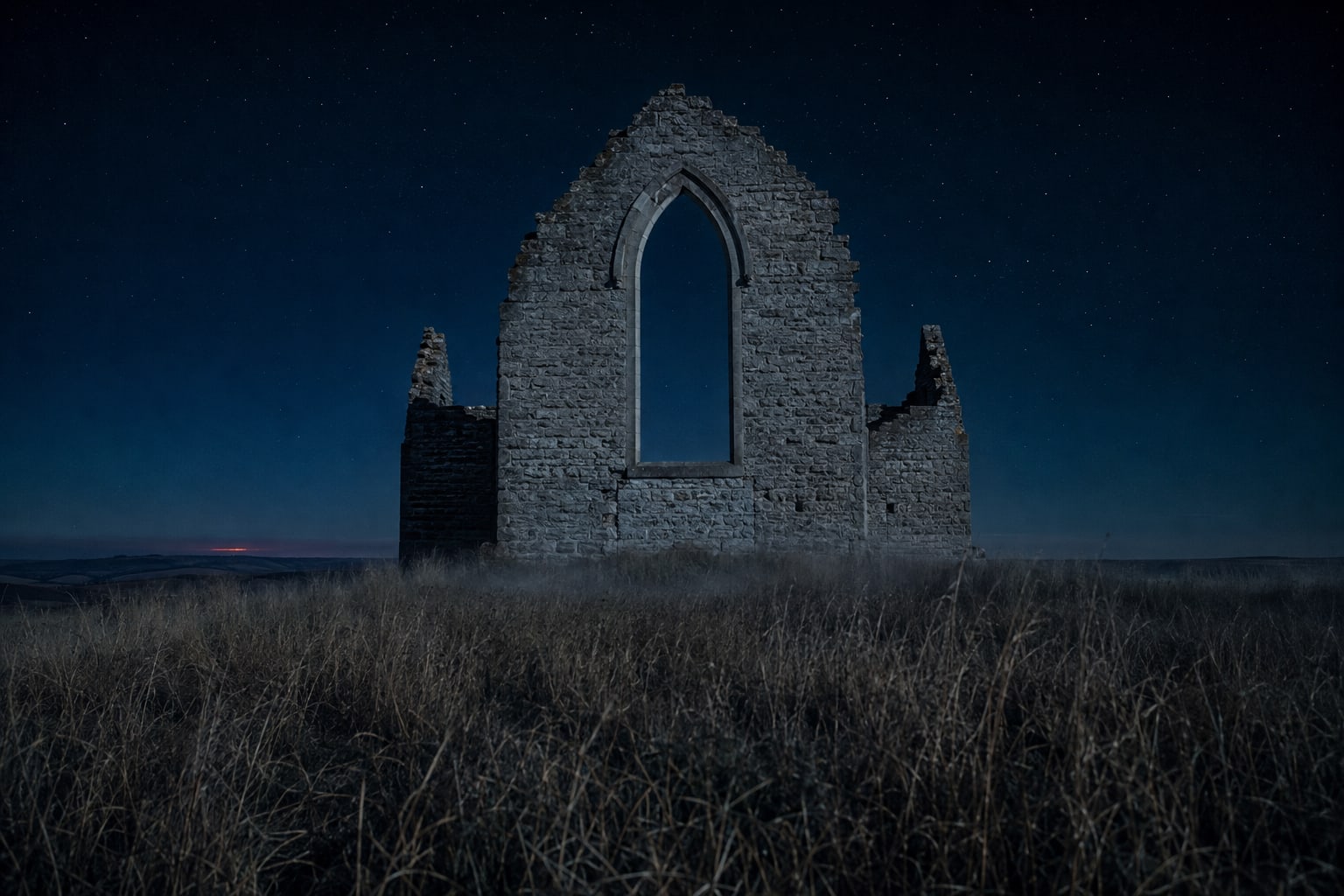
We parked. We crept up the hill. The church was exactly what you want a hellmouth to be — abandoned since 1922, roof long gone, two stone walls standing against the sky like something a metal band would airbrush on a van.
And I did it. I climbed up and I jumped through that window, fully committed, arms crossed over my chest like a man stepping into a baptism, ready for the red-laced walls and the fire and the brimstone.
I landed in grass. Regular grass. Kansas grass.
Shortly thereafter the Douglas County Sheriff's Department arrived to inform us that the only underworld we were entering that night was the inside of a citation if we didn't clear out, and we cleared out. Mission technically accomplished. I jumped through the portal to Hell. The portal to Hell turned out to be a window into a slightly colder part of the same field.
I stayed mildly disappointed about this for years. Then I learned the actual history of the Stull legend, and I'm here to tell you: the truth is so much better than brimstone.
The Legend Was Invented By A College Newspaper
Here is the thing about Stull's "century-old" folklore. It cannot be found in print — anywhere — before November 1974.
That month, the University Daily Kansan, KU's student paper, ran an article by a student journalist named Jain Penner titled "Legend of Devil Haunts Tiny Town." It reported that Stull was "haunted by legends of diabolical, supernatural happenings," that the cemetery was one of two places on Earth where the Devil personally appears twice a year, and that the old church hid the way down. The article cited student accounts. It cited no historical record, because there wasn't one.
Residents of Stull — actual people who had lived their whole lives next to this graveyard where their parents and grandparents were buried — said they had never heard any of it before the article ran.
Read that again. The people of the town with the portal to Hell learned about their portal to Hell from a college newspaper.
And it worked. God, did it work. Within years, hundreds of students were descending on the cemetery every Halloween. They knocked over headstones. They stole grave markers for dorm rooms. They left beer cans among the graves of German farmers. By the nineties the place needed a chain-link fence and regular sheriff's patrols, and trespassing at Stull today will cost you a real fine and possibly a stint in jail, which I did not know when I was mid-air through that window and am choosing not to think about now.
The Pope, And The Magazine Article That Doesn't Exist
But my favorite part of the Stull legend — the part that made me fall in love with it as an adult — is the Pope story.
The story goes like this: in 1993, Pope John Paul II flew to Denver for World Youth Day, and he ordered his plane to divert around eastern Kansas because he refused to fly over the unholy ground of Stull. This is the legend's crown jewel, its proof of legitimacy. The Vatican itself acknowledges the gateway. And the story is always, always attributed to the same source: Time magazine reported it.
No such Time article exists. It never existed. Researchers have looked. Snopes has looked. There is no evidence the flight diverted around anything at all. The legend's most famous piece of evidence is a citation to a magazine story that was never written.
Which means the Stull legend is counterfeit all the way down. A newspaper article invents the folklore, and then the folklore invents a newspaper article to prove itself. It's a snake eating its own byline. As a person who publishes a horror site for a living, I have never respected anything more.
Even The Demolition Is A Ghost Story
The old church is gone now. On March 29, 2002 — a random Friday — somebody brought demolition equipment up Emmanuel Hill and pushed the walls of the 1867 limestone church inward into a pile. Storm damage had been eating the building for years; the roof went in the mid-nineties and a wall came down early that same year. It was coming down eventually.
Here's the beautiful part. Nobody knew who did it. The Lawrence Journal-World covered the demolition the next day as a genuine whodunit — one of the landowners told the paper he hadn't been informed, hadn't authorized it, and didn't know who had. The neighbors didn't know either. For a stretch, the destruction of the gateway to Hell was itself an unexplained event, and I promise you there are people who will tell you to this day that no human ordered that demolition at all.
The mundane answer surfaced eventually — a landowner had gotten sick of decades of vandals, legend-trippers, and idiots jumping through the window (hello), and had it razed. But a legend powerful enough that its own demolition generates new legend? That is a self-sustaining machine. Stull doesn't need the Devil. Stull runs on us.
The Legacy Is Real Even If The Legend Isn't
One more thing, for the horror fans who've made it this far. If the name Stull itches at your brain, it's because of Supernatural. Eric Kripke has said outright that Sam and Dean Winchester are from Lawrence, Kansas, for one reason: proximity to the Stull Cemetery legend. The show's fifth-season finale — Lucifer and Michael, the final confrontation — is staged in Stull Cemetery. A story invented by a KU student in 1974 grew up to become load-bearing mythology in one of the longest-running horror shows ever made.
That's the actual magic trick, and it's better than a staircase to the underworld. Somebody wrote a spooky story about a real place, and the story got loose. It rewired how an entire region felt about a hill with a graveyard on it. It reached into television. It put four drunk college kids in a Wrangler at 1 a.m. It's still putting them there — ask the Douglas County Sheriff.
There was never a portal to Hell in Stull, Kansas. There was something weirder: proof that a good horror story, released into the wild, does not need to be true to become real.
I jumped through the window anyway. I'd do it again.
Horror doesn't stop when the article ends.
Get your Scare Score. Talk to Hex. Take the horror quiz. Join a community that lives and breathes horror.
“Final Girl” Isn’t as Old as You Think. A Viking Scholar Coined It in 1987.
Laurie, Sally, Nancy, Sidney — we talk like “Final Girl” has always existed. It was coined in 1987 by a medieval Scandinavian literature professor, her actual argument wasn’t the virgin-survives checklist, and the term’s escape into Hollywood rewrote the genre it described.
The Lizzie Borden Rhyme Gets Every Single Fact Wrong
"Forty whacks" was eighteen or nineteen. The axe was a hatchet. Her mother was her stepmother. And America's most famous axe murderer was acquitted in ninety minutes. On the anniversary of the Borden murders, an audit of the most successful wrong poem in American history.
HELLBOUND HEARTS — hellboundhearts.com