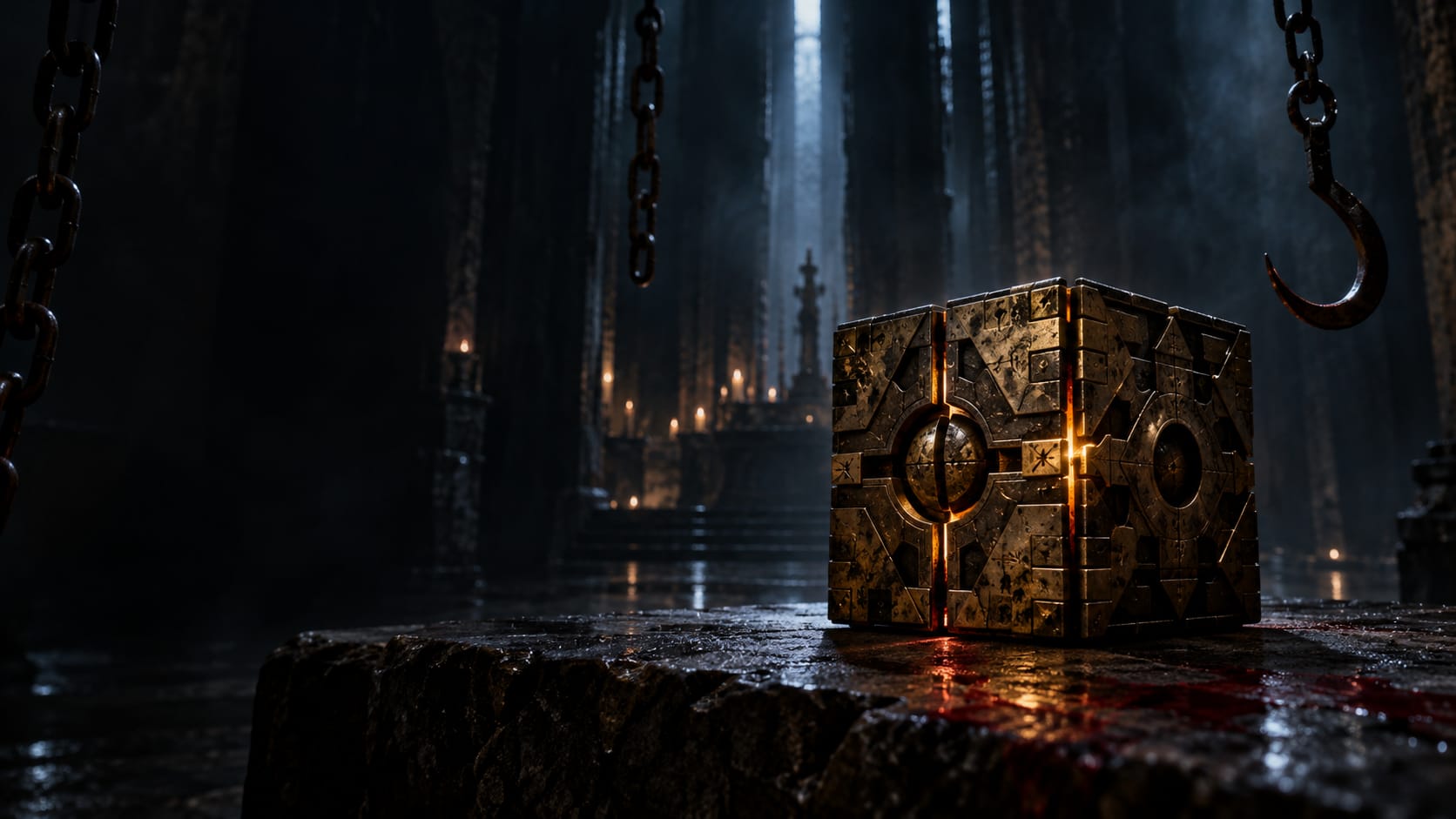

The Box Has Changed Hands Again
Hellraiser: Revival is out, Doug Bradley is the Hell Priest again, and Clive Barker reclaimed his own box before announcing three new books at 74. One fan who came to it backwards takes stock.
Allen Erwin·Hellbound Hearts·October 9, 2026·8 min readYesterday, October 8, the box changed hands again. Clive Barker's Hellraiser: Revival is out, the first Hellraiser video game ever made, and the voice coming out of your speakers when the Cenobites arrive belongs to Doug Bradley, playing Pinhead in a Hellraiser story for the first time since 2005. He did lend the voice to Dead by Daylight's guest version a few years back, but a crossover cameo in someone else's game is a different thing than the Hell Priest standing in his own house. Barker consulted on the story. Four days ago he turned seventy-four. I meant to have this posted the minute the servers went live and I missed by a day. Barker waited forty years for this one. You can wait twenty-four hours for me.
The puzzle box has been passed around for four decades, through studios and lawsuits and sequels nobody asked for, and this week it lands in the one place it has never been: your hands, with a controller in them. That's a strange sentence to write about a franchise I've loved since the beginning, so let me explain what the box did to me first.
It Went Backwards
Here is the honest confession for the readers who keep lists: I had never heard of Clive Barker until Hellraiser came out in 1987. He had already published the Books of Blood, Stephen King had already announced him as the future of horror, and none of that had reached me. The movie reached me. I fell in love with it immediately, in the way you only get to fall for a few films in a lifetime, where you walk out different than you walked in.
What happened next almost never happens. The movie sent me to the book. Every other time in my life it's gone the other direction: I find the novel, I love the novel, I wait for the movie, the movie disappoints me, I complain about it to people who didn't ask. Hellraiser reversed the current. I went looking for The Hellbound Heart, the 1986 novella the film came from, because I needed to know where that thing had come from. Then I bought every sequel the franchise produced, which is a sentence I'd like to walk back about half of. They were not all great. Several were not good. A couple exist for reasons that have more to do with contract law than storytelling, and we'll get to that, because it's the whole point.
The Book Is Not the Movie
The differences between The Hellbound Heart and Hellraiser are the kind that reorganize how you watch the film. In the novella, Kirsty isn't Larry's daughter. She isn't anyone's daughter. She's a friend of the family with an unrequited crush on the husband, who's named Rory, not Larry, and the film's decision to make her a daughter changed the entire emotional architecture of the thing. Julia's menace, Frank's seduction, the stakes of the attic: all of it lands differently when the woman at the center is a stepdaughter instead of a lovesick acquaintance.
And then there's the Cenobite. In the book, the one with pins through its head is not in charge. It's described, grid tattooed across the skull, a jeweled pin at every intersection, but it's one of four, and the one who does the talking has a voice Barker describes as light and breathy, like an excited girl. The Cenobites in the book are gender-ambiguous theologians of pain. The film gave the pins a leader's authority, Doug Bradley's voice, and a stillness that made the character an icon before he'd finished his first scene. He was credited only as "Lead Cenobite." The crew called him Pinhead. The name stuck, and Barker has spent forty years politely hating it. He calls the character the Hell Priest, and when he finally wrote him a novel of his own, The Scarlet Gospels, that's the name on the page. I've always loved the stories of the priest. I've just never called him that out loud at a convention, because nobody would know who I meant.
The crew called him Pinhead. The name stuck, and Barker has spent forty years politely hating it.
The Second One, and the Thing It Took
Hellbound: Hellraiser II came out in 1988 and I enjoyed it enormously. It's bigger, stranger, more willing to show you Hell itself, and the Channard Cenobite is one of the great practical-effects creations of the decade. But it also did the thing that bummed me out more than any single moment in the franchise, and I've had thirty-eight years to decide whether I was right to feel that way.
It showed me Pinhead without his pins.
Captain Elliott Spencer, British Army, a man broken by the First World War who opened the box looking for something and found the Order of the Gash instead. The movie hands you his photograph, his history, his humanity. And I understood, even then, that something had been spent that could not be recovered. A monster you can explain is a monster you can forgive, and forgiveness is the one thing the Hell Priest should never be offered. The best horror villains are weather. The second film made him a man with a backstory, and every sequel afterward had to live in that smaller room.
I don't blame Doug Bradley for any of it. He played the character in eight films across eighteen years, and the stillness is his. I've watched him in other things and enjoyed none of them as much, which isn't a knock on him. It's that the role fit him like a glove fits a hand, which is to say it fit so well there was nowhere for the two of them to go after. When the franchise recast the part, first in 2011, then in 2018, and then again for the 2022 reboot, each new performer was competing with a voice that had already been nailed to the inside of my skull. That's why this week matters more than a game release should. Bradley is the voice again. The box is in the right hands.
Where the Box Led
The sequel that bummed me out was still worth it, because the whole franchise functioned as a doorway. Hellraiser led me to Nightbreed, which led me to Cabal, the novella Nightbreed was made from, and that one was a heartbreak of a different kind. Barker directed it himself in 1990, Fox panicked, recut it into a slasher it never was, and marketed David Cronenberg's masked killer as the star of a movie that was supposed to be about the monsters being the good guys. It took until 2014 for a director's cut to surface and show us the film Barker actually made. Fantastic movie. Mistreated movie. Those two things are often the same thing.
It led me to the Books of Blood, finally, years late, the six volumes that made King write his famous sentence and gave the world Candyman out of a story called The Forbidden. It led me to Weaveworld. It led me to Imajica, which is the better part of a thousand pages of a man building five whole worlds because one wasn't enough to hold what he wanted to say, and I'm still not sure I understood all of it, and I'm sure it was worth the trying. Barker's books taught me that horror and beauty aren't opposites. They're the same substance at different temperatures.
And somewhere in all that reading I learned about the man. He's dealt with a great deal. In 2012 toxic shock syndrome put him in a coma, and for years afterward his health and his output both went quiet in a way his readers felt. You can see his life in the work, in my opinion. The flesh that's always a threshold. The transcendence that always costs something. The outsiders in Midian who are the heroes. A Liverpool kid who grew up to insist that the monstrous and the sacred were the same door, and then lived long enough to prove it personally.
Whose Hands
So here's why the title isn't just a metaphor.
The box has literally changed hands, repeatedly, and badly. New World released the first film, but the rights underneath it sat with the production company, and they would stay in that corporate lineage for decades. The sequels went to Dimension, the Weinstein label, from the early nineties through 2018, and there they spent more than two decades as a rights obligation: Dimension had to keep producing Hellraiser films to hold onto the property, so Hellraiser films got produced. That's the explanation for the back half of my collection. Revelations was shot in about two weeks on roughly three hundred thousand dollars, Doug Bradley declined to appear in it, and its own screenwriter later called it a cinematic ashcan copy. Those weren't movies. They were paperwork with Cenobites in it. Then Spyglass took over, and the 2022 reboot came out of that arrangement.
And then Clive Barker took back his own box. In December 2019 he served a termination notice under the copyright provision that lets authors reclaim their work after thirty-five years. The company holding the rights, Park Avenue Entertainment, successor to the entity he'd signed them to back in 1986, pushed back, so he sued in 2020. They settled before the end of that year, and on December 19, 2021, the US rights to The Hellbound Heart and the original screenplay reverted to him. Not the sequels. Those stay where they are. But nothing new gets made from his story in this country without him, and the rights Park Avenue had been sitting on specifically included television and video games. Read this week's release date again with that in mind.
Those weren't movies. They were paperwork with Cenobites in it. Then the man who made the box got the box back.
Which makes what he did this August make a lot more sense. Barker announced three new books, Fear Eternal, Pyres of Bedlam, and Dark Descents, collectively called Library of the Dead, billed as the spiritual successor to the Books of Blood, with his own illustrations and poetry in every volume. And he's publishing them through Kickstarter. When I first saw that, I'll admit it surprised me. A writer of his stature going the crowdfunding route read, for a second, like a step down. It isn't. It's the same move as the lawsuit. It's a man in his seventies choosing to sell directly to the readers who have been waiting for him, through his own imprint, on his own terms, with no studio in the middle to recut anything. The campaign blew through its goal almost immediately. He announced, in the same breath, that he's made a full recovery. I'll be backing it, or late-pledging it, or whatever the verb is now. Of course I will. I've bought every bad sequel. I can certainly buy the good books.
This Week
Revival isn't an adaptation. It's a new story, a new town, a new box called the Genesis Configuration, a guy named Aidan trying to pull his girlfriend back out of the Labyrinth. Hell Chains. Pyrokinesis. Butterball and Chatterer on the roster. Saber Interactive has a track record with horror adaptations, Barker's fingerprints are on the story, and Bradley is at the microphone. I have no idea yet if it's good. I'll tell you honestly when I do.
But I know this much. Forty years ago a box fell into my hands sideways, movie first, book second, every sequel third, and it changed how I read and what I thought horror was allowed to want. This week it's in a new set of hands, and for the first time in a long time, the hands that matter most are the ones that made it.
Open it. Carefully. You know how this works.
Horror doesn't stop when the article ends.
Get your Scare Score. Talk to Hex. Take the horror quiz. Join a community that lives and breathes horror.
“Final Girl” Isn’t as Old as You Think. A Viking Scholar Coined It in 1987.
Laurie, Sally, Nancy, Sidney — we talk like “Final Girl” has always existed. It was coined in 1987 by a medieval Scandinavian literature professor, her actual argument wasn’t the virgin-survives checklist, and the term’s escape into Hollywood rewrote the genre it described.
The Lizzie Borden Rhyme Gets Every Single Fact Wrong
"Forty whacks" was eighteen or nineteen. The axe was a hatchet. Her mother was her stepmother. And America's most famous axe murderer was acquitted in ninety minutes. On the anniversary of the Borden murders, an audit of the most successful wrong poem in American history.
HELLBOUND HEARTS — hellboundhearts.com